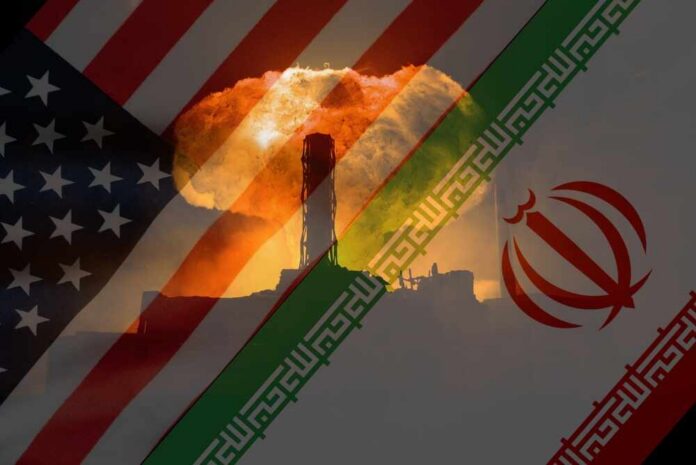
As Iranian missiles and drones arc across the Gulf toward U.S. bases and civilian hubs in Kuwait and Bahrain, both Washington and Tehran still insist a “ceasefire” exists—highlighting how far official narratives have drifted from the reality ordinary people are living under.[3][4]
Story Snapshot
- Iran fired ballistic missiles and drones toward Bahrain and Kuwait, with U.S. Central Command reporting multiple interceptions but also damage and injuries on the ground.[3][4]
- Kuwait and Bahrain officially labeled the attacks a “serious escalation,” warning that vital energy and transport infrastructure are now in the crosshairs.[3][4]
- Iran’s Revolutionary Guard framed the strikes as retaliation for U.S. attacks on an Iranian tanker and military facilities, while vowing stronger future responses.[3]
- Both Iran and the United States still claim a ceasefire and ongoing diplomacy, deepening public distrust as fighting continues despite official reassurances.[1][3]
Missiles Over Kuwait And Bahrain Under A Supposed Ceasefire
U.S. Central Command says Iran launched ballistic missiles at Kuwait and Bahrain, targeting American bases and associated facilities, while also sending drones toward regional sites that host U.S. forces.[3][4] Kuwaiti officials report their air defenses intercepted incoming missiles and drones but confirm that drones struck the country’s international airport, causing significant damage and multiple injuries.[3] Bahraini authorities activated air raid sirens and say warning systems and defenses engaged missiles aimed at the headquarters of the U.S. Fifth Fleet.[3]
Bahrain’s government publicly called on Iran to halt the attacks and described the launches toward U.S. bases in Bahrain and Kuwait as unacceptable aggression.[4] Kuwait’s Foreign Ministry went further, labeling the strikes a “serious escalation” and stressing that some of Iran’s earlier drones caused heavy damage to a passenger terminal at Kuwait’s main airport and killed one person, though Iran denies responsibility for that incident.[4] These statements reflect how Gulf governments see their territory and civilians being pulled into a conflict they did not start.
Retaliation Narrative Versus Escalation Fears
Iran’s Islamic Revolutionary Guard Corps says the strikes on Bahrain and Kuwait were retaliation for a U.S. attack on an Iranian oil tanker near the Strait of Hormuz and for subsequent U.S. strikes on communication facilities on Qeshm Island.[3] Tehran has portrayed its campaign as part of a broader war with U.S. bases in the region, insisting that Gulf states are not the primary targets but warning they will be treated as hostile if they facilitate U.S. attacks.[2][3] This framing lets Iran claim self‑defense while still firing across multiple borders.
U.S. Central Command counters that its own strikes on Qeshm Island were carried out in self‑defense after Iran attempted attacks against “regional neighbors,” and says U.S. forces helped intercept missiles aimed at Bahrain while other Iranian missiles targeting Kuwait broke apart or fell short.[3] Washington maintains that its actions are defensive and that a ceasefire technically remains in force, even as missiles fly.[3] For people living under these trajectories, the distinction between “retaliation” and “escalation” offers little comfort.
Civilian Infrastructure And Energy Networks In The Firing Line
Recent attacks fit into a wider Iranian pattern of using drones and missiles to pressure not just militaries but energy, aviation, and economic infrastructure across the Gulf.[1][4] Kuwait reports that waves of Iranian drones have targeted vital oil installations, power plants, and water desalination facilities in the south, causing serious damage.[1] In neighboring states, debris from interception operations has already injured civilians and damaged industrial sites, including a gas‑processing facility and residential neighborhoods.[1]
🚨 BREAKING: Iran launches attacks on Bahrain and Kuwait.
Missiles and drones reported. Air defenses activated.
A significant escalation in the Gulf.
— 🌍Karry (@Kamlesh5459) June 6, 2026
Analysts at the Center for Strategic and International Studies describe Iran’s drone campaign in the Gulf as a sustained coercive system that repeatedly targets energy hubs, airports, and industrial zones rather than a series of isolated incidents.[4] Their data show that drones account for the majority of recorded strikes, with ballistic and cruise missiles adding destructive weight.[4] Every hit or near‑miss at a refinery, power station, or port stacks risk onto global oil markets and, ultimately, consumer prices far beyond the region.
Diplomacy, Deep Distrust, And A Growing Sense Of Elite Failure
Even as missiles cross borders, Iranian and U.S. officials both insist that diplomatic channels remain open and that a ceasefire has not been formally abandoned.[1][3] Iranian media report that work on a memorandum of understanding has “paused” and that Tehran demands tangible verification before any breakthrough, while the Iranian foreign minister publicly denies that Iran has asked for a ceasefire or exchanged formal messages with Washington.[2][3] U.S. leaders, for their part, push back against reports of stalled talks and portray negotiations as ongoing.[3]
This split between official reassurances and visible conflict reinforces a perception shared by many Americans—left and right—that foreign policy is being run by insulated elites who face little accountability when their “managed” conflicts spill over into civilian airports and energy grids.[1][3][4] Each new “limited” strike that risks a wider war, upsets energy markets, and feeds inflation at home strengthens doubts that either party in Washington is serious about putting ordinary people’s security and prosperity ahead of geopolitical gamesmanship.[1][4]
Sources:
[1] Web – Iran Fires Off Missiles In ‘Serious Escalation’ Toward Gulf Neighbors …
[2] YouTube – Iran Launches Drone and Missile Assault Across the Gulf | ET Now
[3] YouTube – Iran launches drone and missile strikes across Gulf countries in …
[4] YouTube – Iran Launches 7 missiles At Kuwait And Bahrain