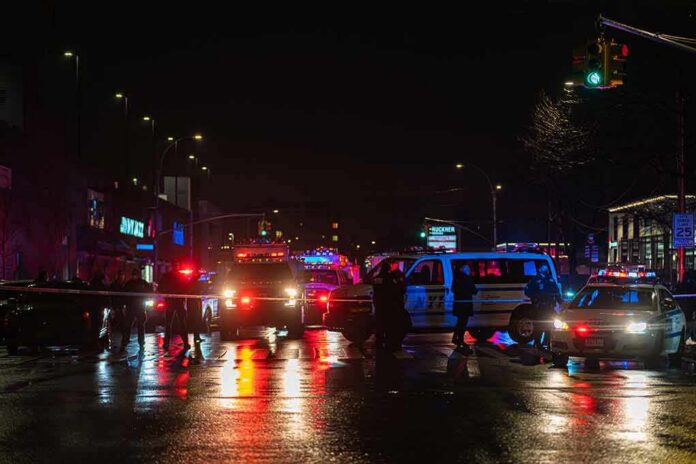
Police say a 63-year-old man set himself on fire inside a Manhattan lobby that houses Google offices and New York City Police Department Internal Affairs, shocking workers and raising urgent safety questions.
Story Snapshot
- A 63-year-old man self-immolated inside 315 Hudson Street just before 3 p.m., police said.
- Security staff put out the flames; medics took the man to a hospital, condition not released yet.
- The building includes Google offices and the New York City Police Department’s Internal Affairs Bureau.
- No arrests were announced as police continued the investigation.
What Happened Inside the Hudson Street Lobby
New York City Police Department and Fire Department officials said the man ignited himself in the lobby of 315 Hudson Street, near Vandam Street, just before 3 p.m. Friday. Building security used equipment to douse the flames before emergency crews arrived, according to initial reports. Medics then took the man to a local hospital. Authorities did not immediately release his name or a motive. Police did not announce any arrests, and the inquiry remained open late Friday.
The address houses Google offices, along with the New York City Police Department’s Internal Affairs Bureau, which investigates officer misconduct. The location guarantees attention. It also complicates early guesses about motive. Officials have not said whether the man targeted a company, a police unit, or simply a busy public space. Police often wait to confirm identity and intent until they notify family and review evidence such as notes, video, or witness statements.
Safety, Security, and the Public’s Daily Routine
Large office towers use layered security: staffed lobbies, cameras, and extinguishers. Friday’s response appears to have worked fast enough to save a life, at least in the short term. Still, an open lobby lets visitors enter with ordinary items that can become fuel. That tradeoff sits at the center of many urban buildings: free movement for workers and guests, but with risk that cannot be cut to zero. New York City has lived with that balance for decades.
Workers now want to know what will change on Monday. Property managers can add bag checks or more guards, but those steps slow access and add cost. Police can increase patrols, but officers already face stretched workloads. These choices land in a climate where many Americans distrust large institutions, from big tech to law enforcement. People on the right and left agree on this much: they do not feel heard, and they doubt that those in charge will fix root problems quickly.
How This Fits a Wider Pattern of Self-Immolation
Scholars who study self-immolation say it is a rare but long-running form of protest aimed at a wider audience, not at bystanders in the moment. Oxford sociologist Michael Biggs has documented thousands of such acts worldwide since the 1960s, often in waves tied to political or social stress. News coverage is immediate because the act is shocking. Clear motives often take days to confirm. That pattern helps explain why officials held back firm claims about intent on Friday.
New York City saw a separate self-immolation this summer outside the United Nations that was linked to a political cause and ended in death, showing how lethal and symbolic these acts can be. Friday’s incident was different in place and details, yet it triggered the same questions: what message was meant, why there, and who was the intended audience? Until police share more, those answers remain limited to confirmed facts and cautious context.
Why the Location Matters to Public Trust
Choosing a lobby shared by a global tech firm and a police oversight unit invites strong reactions. Many conservatives blame big tech for bias and overreach. Many liberals mistrust police systems they see as unaccountable. Both sides, however, share a deeper worry: powerful institutions seem detached from everyday struggles. An act this extreme will revive that debate, whether or not investigators find a specific political motive behind it.
City leaders now face two tasks. First, they must share clear updates on the man’s condition, identity, and motive once verified. Second, they should explain any security changes that affect workers and visitors at 315 Hudson Street and similar buildings. Straight facts calm a shaken public. Humility and speed matter too. People want to know that safety procedures worked, that lessons will be applied, and that the human being at the center of this is getting care.
Sources:
thegatewaypundit.com, nypost.com, timesnownews.com, amny.com, cnn.com, westernjournal.com