

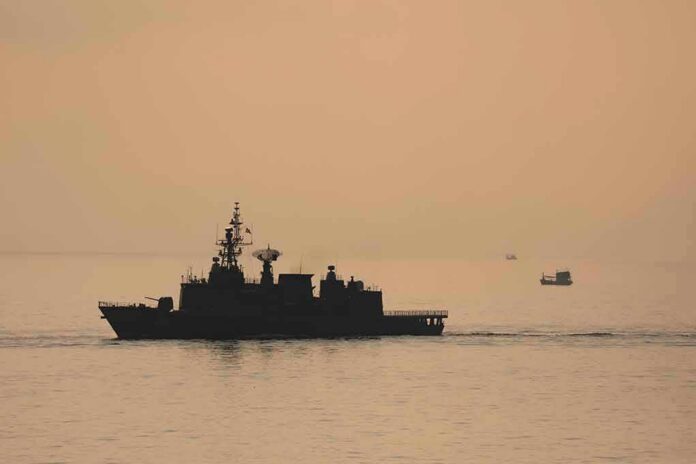
Two cargo ships sank within 24 hours of each other near the Strait of Hormuz after being hit by projectiles, leaving containers and wreckage scattered across one of the world’s busiest oil shipping lanes.
Quick Take
- A Singapore-flagged container ship, the GFS Pride, sank after catching fire from a projectile strike; all 21 crew members survived.
- A separate dry bulk carrier also sank near the strait in a second, unrelated strike within the same 24-hour window.
- The strait carries about 20% of the world’s oil and nearly 30% of its liquefied natural gas, so any disruption ripples through global energy markets.
- Shipping insurance costs have jumped sevenfold as sailors demand hazard pay to risk the passage.
Two Ships Down In One Day
Maritime officials said Wednesday that a container ship and a dry bulk carrier both sank near the Strait of Hormuz after being struck by projectiles in two separate incidents. The attacks happened within roughly 24 hours of each other, according to Reuters, which cited maritime-security sources tracking the wreckage and vessel movements in real time.
The Singapore-flagged GFS Pride, a container ship built to carry 2,824 shipping containers, caught fire after the strike and later sank. Singapore’s maritime authority confirmed all 21 crew members made it off safely. A sister vessel, the GFS Giselle, was also hit in the same stretch of water but managed to reach anchorage instead of sinking.
A Pattern Of Attacks Near A Vital Chokepoint
These sinkings did not happen in isolation. Iran’s Islamic Revolutionary Guard Corps has separately claimed credit for striking other vessels passing through the strait in recent weeks, including a Togo-flagged tanker called the Trend that it accused of making an illegal passage. The research does not show the same group claimed responsibility for the GFS Pride or the dry bulk carrier, and the projectiles in those two cases remain unidentified.
The Strait of Hormuz sits between Iran and Oman and is one of the most important waterways on Earth for energy trade. Roughly 21 million barrels of oil pass through it every day, along with close to 30% of the world’s liquefied natural gas shipments. Any slowdown there tends to show up quickly in fuel prices far from the Middle East.
Traffic Drops As Insurance Costs Soar
Shipping traffic through the strait has fallen to its lowest level since July as more vessels avoid the route altogether. Commercial exports of crude oil, petroleum, and liquid chemicals through the broader region dropped sharply in early October compared to the start of the month. Shipowners that still send vessels through are paying far more to protect them.
War-risk insurance premiums for ships crossing Hormuz have climbed sevenfold, and a $40 billion global safety net has emerged to help cover the growing risk. Sailors willing to make the dangerous crossing are now being offered large bonuses on top of normal pay, a sign that the danger is being priced directly into everyday shipping costs.
Eyewitness footage shows containers and debris floating at sea off the coast of Oman after reports that a container ship sank near the Strait of Hormuz after being hit by a projectile. pic.twitter.com/CbmT8PxxxE
— #Anonymous (@TheStripesGirl) October 15, 2026
This is not the first time Hormuz has been a flashpoint. During the Iran-Iraq War of the 1980s, both countries attacked tankers and laid mines in the Persian Gulf near the strait, a period often called the “Tanker War.” That history shows how quickly a narrow waterway can become a target when regional tensions rise, though the earlier conflict mostly involved mines and openly claimed strikes rather than the unattributed projectile hits reported this week.
For now, no single group has publicly claimed responsibility for sinking either the GFS Pride or the dry bulk carrier. What is confirmed is simpler and more immediate: two ships are gone, their cargo is floating in open water, and the busiest oil route on the planet is getting more dangerous and more expensive to use by the day.
Sources:
youtube.com, internazionale.it, saudigazette.com.sa, rferl.org, trend.az, table.media